Apple Hands the Keys to John Ternus — and Gives Him Eight Days to Prove It
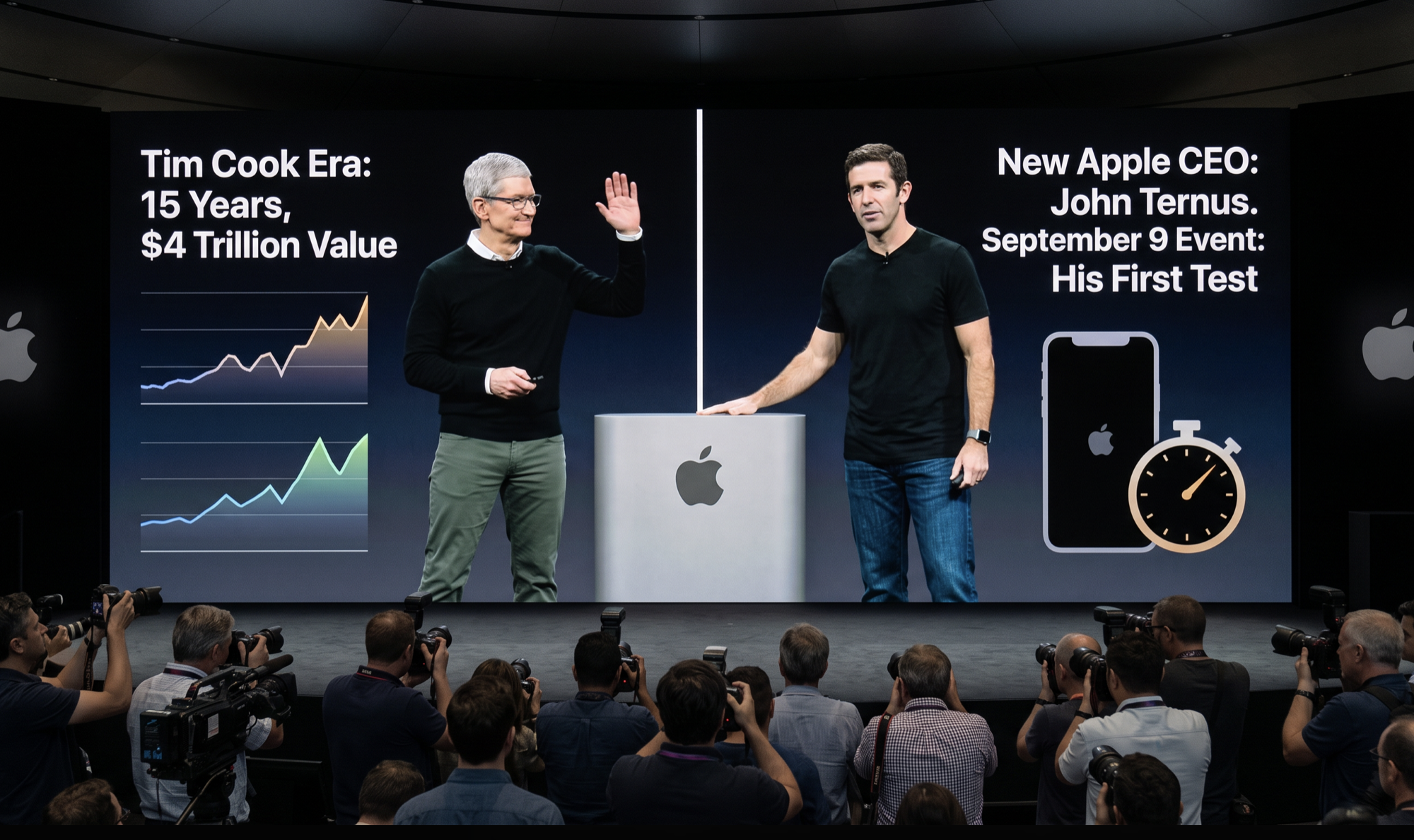
Apple (NASDAQ: AAPL) opened a new chapter Tuesday when John Ternus formally took over as chief executive, ending Tim Cook’s 15-year run at the top of the world’s most valuable consumer technology company. Cook did not leave the building, however. He moves into the executive chairman seat, where he will continue steering Apple’s Washington relationships. Meanwhile, Ternus inherits a September 9 iPhone launch that arrives just over a week into his tenure.
Key Points
- The handoff: Ternus became CEO Tuesday, September 1; Cook’s final day was August 31
- Cook’s record: Apple’s market value climbed from roughly $350 billion to more than $4 trillion across his 15 years
- Cook’s new role: Executive chairman, with an expected focus on the company’s relationship with the Trump administration
- Ternus’s background: Longtime hardware engineering chief who shipped Apple Watch, AirPods, and Vision Pro
- First test: The September 9 iPhone launch event in Cupertino
- Stock reaction: AAPL slipped 1.5% on Cook’s last day, then rallied 3% after Ternus posted his first message on X
An Operator Follows an Operator
Apple’s board chose continuity over reinvention. Ternus built his career inside the product organization rather than finance or services, and he owns the shipping record to prove it. Therefore, the appointment signals that Apple intends to defend its position through hardware execution rather than a strategic pivot.
That choice carries risk. Cook succeeded a founder by optimizing what already existed — supply chains, margins, and scale. Ternus, by contrast, takes over a company that critics say has fallen behind precisely where the next decade will be decided.
The AI Problem Arrives Immediately
Apple lags its megacap peers in artificial intelligence, and the market knows it. Consequently, the September 9 event functions as more than a product launch — it is Ternus’s opening argument.
Analyst Brian Mulberry framed the bar plainly, arguing that Ternus must demonstrate “AI will be more than an app on the iPhone, more than Siri.” In other words, incremental Siri improvements will not satisfy a valuation built on premium expectations.
Beyond AI, the new CEO must manage tariff exposure, supply chain complexity, and an active legal fight with OpenAI over alleged trade secret theft.
What Investors Should Watch
Wall Street appears willing to extend some patience. Analyst Tom Forte estimated Ternus will receive a “six- to 12-month grace period” before the market judges him seriously. Nevertheless, that clock starts now, and the first data point lands September 9.
Additionally, Cook’s continued presence as executive chairman cuts both ways. It preserves institutional knowledge and political access during a tariff-sensitive period. However, it also raises the familiar succession question of whether a new chief executive can move decisively while his predecessor remains in the boardroom.
For investors, the September 9 event is the near-term catalyst. The longer-term question is whether an engineering-first CEO can close an AI gap that engineering alone did not create.