Brent Crude Tops $100 as US-Iran Escalation Chokes the Strait of Hormuz
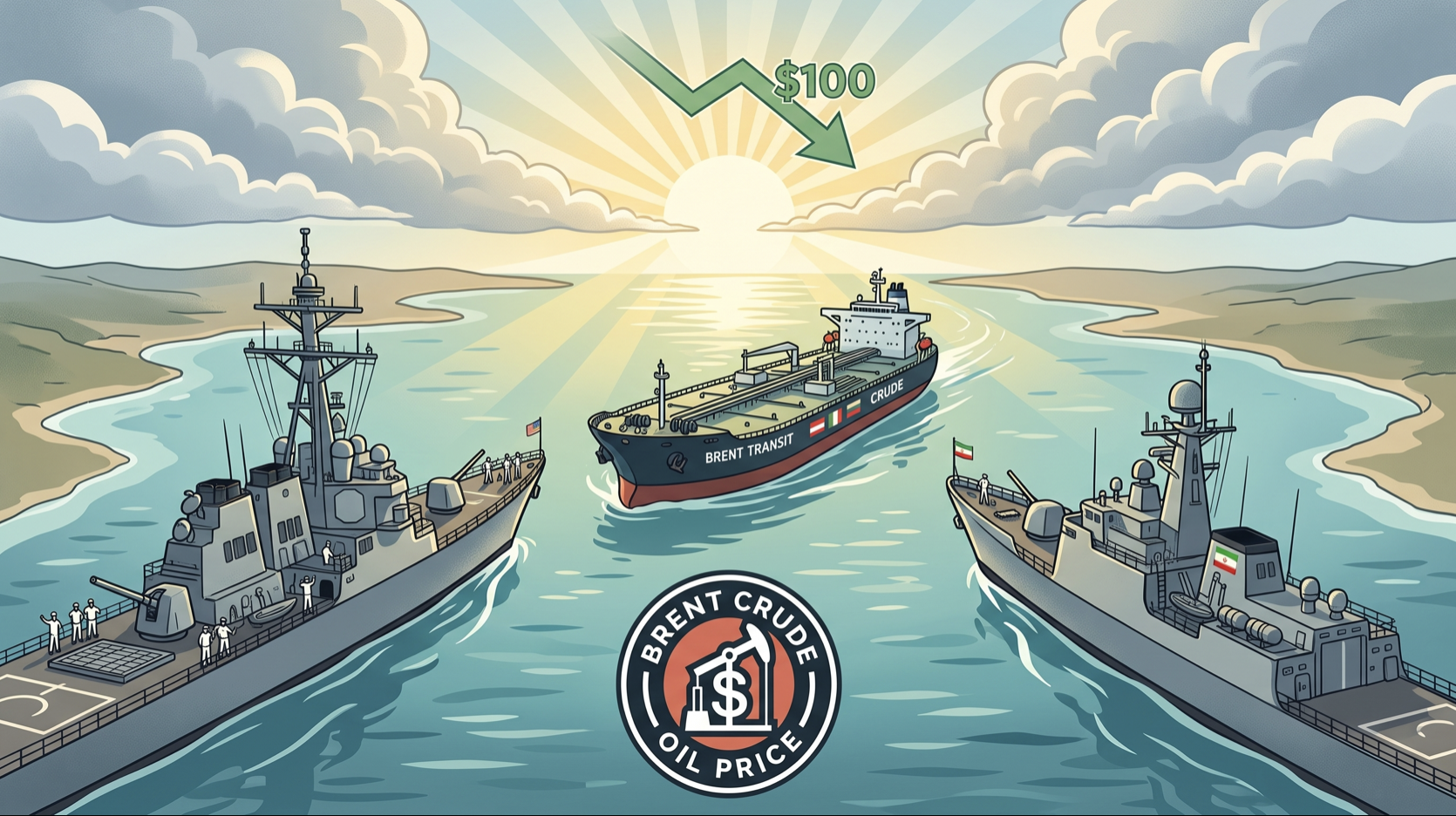
Brent crude crossed $100 per barrel on Wednesday for the first time in roughly two months, as renewed US-Iran hostilities and mounting disruption across the global oil complex pushed the international benchmark back into triple digits. Brent (BZ=F) futures climbed about 3% to trade near $100.65, while US benchmark WTI (CL=F) gained more than 2% to push past $95.
Key Points
- Brent crossed $100 for the first time in about two months; WTI moved above $95.
- US forces sank five Iranian crude tankers overnight — the second strike on Iran’s shipping sector in two days.
- The Strait of Hormuz, which once carried roughly 20% of global crude flows, remains severely constrained in the conflict’s seventh month.
- Goldman Sachs (NYSE: GS) warns futures could reach $120 if disruptions widen, though its base case still calls for Brent at $85 in December.
- US gasoline averaged $4.22 per gallon and diesel held at $5.94, keeping pressure on consumers and on Washington ahead of the midterms.
Military Escalation Reprices the Barrel
The immediate catalyst arrived overnight. US Central Command said American forces sank five Iranian crude oil tankers in response to Iranian attempts to strike US Navy carriers in the region — the second time in as many days that US forces have targeted Iran’s shipping sector. Over the past two weeks, Washington and Tehran have returned to a distinctly kinetic posture, trading strikes after roughly a month of negotiations that had briefly calmed the region.
Consequently, traders repriced supply risk in a single session.
“Oil investors are expressing their view about the impact of the latest bout of escalation in the Middle East in an unambiguous way,” said Tamas Varga, an analyst at PVM Oil Associates. “They are voting with their dollar, and this vote strongly indicates that unless the Strait of Hormuz re-opens, and oil starts flowing again uninterruptedly, supply will not be aligned with demand in the foreseeable future.”
Shipping through Hormuz — responsible for roughly 20% of crude flows before the war — remains severely constrained as operators weigh cargo economics against the risk to crew and vessel.
Pressure Is Building on Four Fronts
Iran is only part of the picture. The global energy market is absorbing simultaneous stress from several directions:
- West: Houthi attacks on Saudi energy infrastructure have revived fears for the several million barrels per day the kingdom routes through the Red Sea — the primary workaround for a constrained Hormuz.
- North: Ukrainian strikes inside Russia have shuttered refining capacity in a market that supplied roughly 10% of global diesel exports before 2022.
- East: Early data shows China, the world’s swing buyer, stepping up crude imports. Its subdued buying through the war had been a key lever holding global prices down.
- Downstream: Refined product stocks remain “worryingly low,” according to Rabobank global strategist Michael Every, while crack spreads — the margin refiners capture converting crude into fuels — sit at all-time highs.
Notably, Persian Gulf crude exports have recovered to roughly half to two-thirds of pre-war levels as Gulf producers lean on pipelines, dark transits, and other workarounds. The bottleneck has shifted downstream: the global refining complex is now running flat out.
Where the Street Sees Prices Going
Goldman Sachs (NYSE: GS) strategists warned Monday that continued disruption to energy flows could drive futures as high as $120 per barrel — above March’s wartime peak. The bank’s base case, however, still has Brent and WTI at $85 and $80 respectively in December.
“The intensity and geographical breadth of tanker attacks — a highly uncertain variable — will remain a key driver of whether Gulf oil exports recover and how quickly,” wrote the Goldman team, led by head of oil strategy Daan Struyven.
Meanwhile, analysts at JPMorgan (NYSE: JPM) flagged how badly the market has misjudged the conflict’s duration.
“The duration of the conflict … has extended substantially beyond what we penciled in back in May, when we expected the Strait to reopen in June,” wrote the JPMorgan team, led by head of global commodities strategy Natasha Kaneva. “Importantly, the market has been making much the same mistake, repeatedly pushing normalization out by a few months, only to roll it forward again as time passes.”
The Cost Lands at the Pump
American drivers are already paying for it. Gasoline averaged $4.22 per gallon on Wednesday, per AAA, while diesel held at $5.94 after clearing a previous all-time high. Because diesel underpins nearly all goods movement, every increase feeds directly into business costs — and ultimately into an inflation reading already running above target.
In Washington, therefore, sticky pump prices have become an acute political problem heading into the midterms, arriving just two months after voters paid the highest Labor Day gasoline prices on record.
The Bottom Line
A conflict once expected to last weeks is now approaching its first anniversary, and the market has repeatedly guessed wrong on when it ends. With Hormuz constrained, Red Sea routes exposed, Russian refining degraded, and Chinese demand turning back up, the balance of risk around crude has shifted decisively to the upside — and the $120 scenario is no longer a tail case.