SBC Medical Builds Its Next Phase of Growth on a 287-Clinic Network

The company is investing in AI-powered clinic operations and expanding into longevity services, using an established network as the foundation.
SBC Medical Group Holdings, Inc. (Nasdaq: SBC) already provides management services to a network of 287 clinics in Japan and overseas. The company now plans to build on that infrastructure in two ways: using AI to improve how clinics operate, and developing new services focused on longevity and preventive health.
Two recent developments show that strategy taking shape. On November 2, SBC Medical announced a ¥600 million investment (approximately US$3.8 million, based on the exchange rate as of October 30, 2026) in clinic software developer AtomicSoftware Inc., forming an alliance to co-develop AI tools for clinics. A week earlier, on October 26, Director, CFO and COO Yuya Yoshida outlined a longevity roadmap at Cantor Fitzgerald Hong Kong’s inaugural Asia Longevity Forum. It begins with blood-based diagnostics in November and extends to personalized care, AI-supported treatment planning and international expansion.
SBC Medical is pursuing both from an established operating base. In the second quarter of 2026, total revenue rose 13% year over year to $49 million, and net income attributable to SBC Medical was $11 million. Adjusted earnings before interest, taxes, depreciation and amortization (adjusted EBITDA), a non-GAAP measure, rose 32% to $20 million, a 41% margin that expanded 6 percentage points year over year. Clinics in the network recorded 6.9 million visits over the twelve months ended June 30, 2026. The company held $184 million in cash and cash equivalents at June 30, 2026, and management says longevity investment will be funded from operating cash flow rather than dilution. SBC Medical plans to release its financial results for the third quarter ended September 30, 2026, before the U.S. market opens on November 13, 2026.
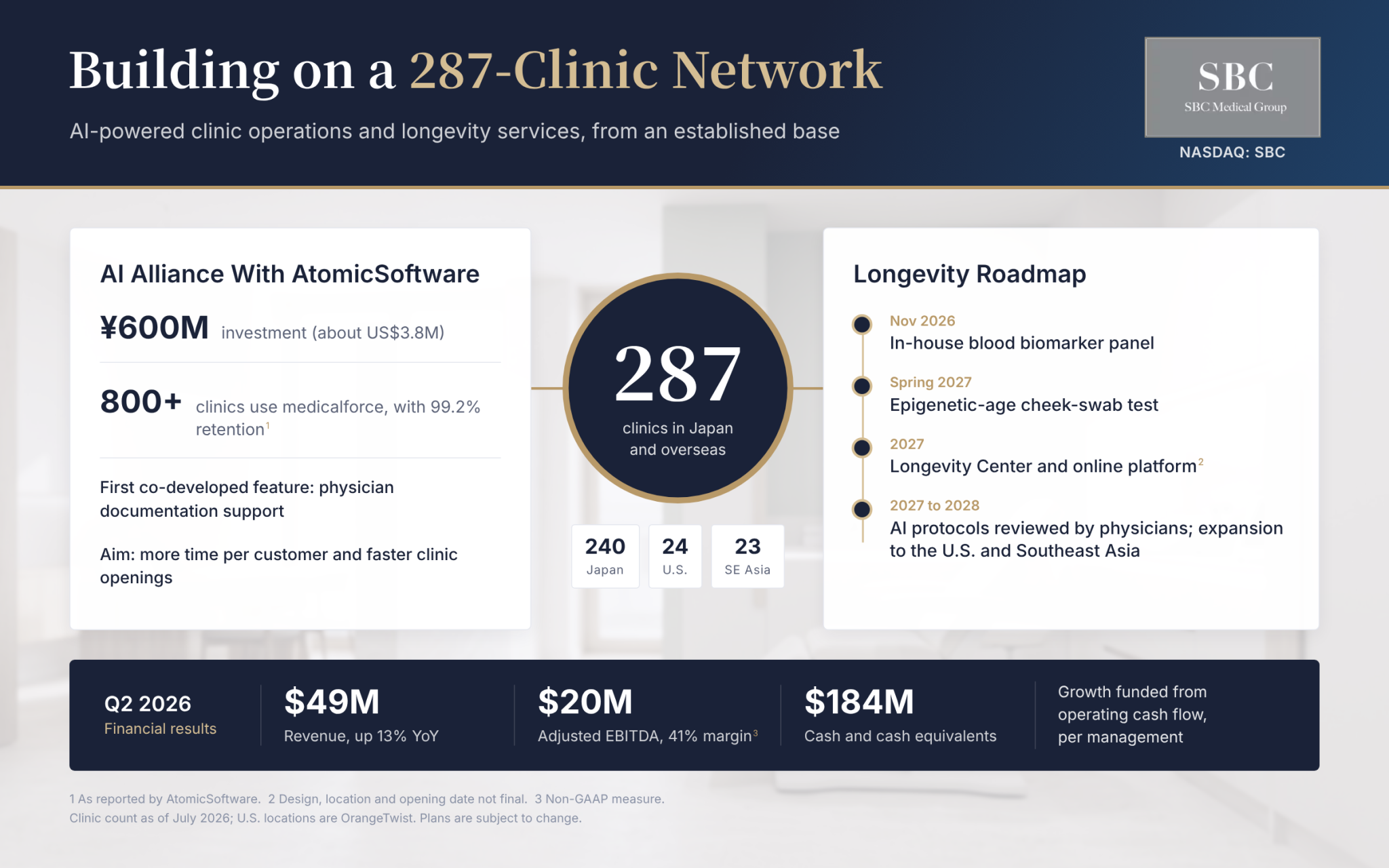
The AtomicSoftware alliance targets clinic economics. AtomicSoftware develops medicalforce, an all-in-one software-as-a-service platform that combines reservations, electronic medical records, payments, customer information management and business analytics. According to AtomicSoftware, more than 800 clinics in Japan used medicalforce as of September 2026, primarily self-pay clinics, and the platform has a clinic retention rate of 99.2% as of March 2026. Hada no Aozora Clinic, a clinic SBC Medical supports, already runs medicalforce as its core operating and payment system.
The two companies will co-develop AI features, beginning with a tool that helps physicians prepare medical records. Features will be validated at clinics SBC Medical supports, then built into medicalforce and SBC Medical’s own clinic operations systems. Documentation was already a target. SBC Medical draws on more than 26 years of accumulated management data for its AI development, and in its forum presentation it listed voice-to-EMR auto charting among six AI products in development.
The intended benefit is economic. Less time spent on documentation and administrative work would free physician and staff time for customers and allow clinics to serve more customers with limited staff. Standardized implementation procedures are also expected to shorten opening preparations for new clinics. Through both, SBC Medical aims to raise productivity and profitability at each clinic.
AI-enabled services are already contributing to results. Management attributed part of second quarter earnings growth to expanded service fees in line with enhanced AI-enabled support. It expects fee revisions for call center services and for expanded support of Rize Clinic and Gorilla Clinic to increase service fees by approximately $15 million annually, if realized for a full year (converted at ¥158.1/US$). That estimate is separate from the AtomicSoftware alliance.
“We chose a capital and business alliance because, rather than buying AI off the shelf, we want to co-create it and build it into our own operating capabilities,” said Yoshiyuki Aikawa, CEO of SBC Medical.
Longevity Through the Existing Network
The longevity roadmap follows the same logic, starting in Japan, one of the world’s oldest populations. Rather than building a new distribution network, SBC Medical intends to introduce longevity services through the clinics it already supports. Yoshida described three layers: diagnose, personalize and intervene. Management views intervention, which requires licensed clinics, physicians and nurses, as the hardest layer to build and the one SBC Medical’s network already provides. A single patient record, SBC ID, is designed to connect the three.
The roadmap presented at the forum includes the following milestones:
- November 2026: an in-house blood biomarker panel, led by group company Waqoo, offered across the clinic network.
- Spring 2027: an epigenetic-age cheek-swab test, also from Waqoo.
- 2027: a flagship Longevity Center and an online platform for coaching and tracking. The center’s design, location and opening date are not final.
- 2027–2028: AI-generated protocols from SBC AI Longevity Innovation (SALI), reviewed by licensed physicians, with the longevity offering extended to the United States through OrangeTwist and to Southeast Asia.
Separately, on October 22, SALI began in-house development of a DNA methylation test to estimate biological age. SBC Medical has not disclosed a timeline for that test.
Management presents diagnostics as a recurring entry point, with personalized protocols and treatment delivered through the clinics. That could broaden the services, and the repeat visits, at clinics SBC Medical supports. Management describes three growth levers for its MSO platform: the number of clinic locations, average fee per clinic and the breadth of the service menu. Longevity services would add to the third, and management has said that growth at supported clinics leads to expanded service fees for SBC Medical. The company has not disclosed revenue projections for the longevity business.
The AtomicSoftware alliance is designed to improve how the clinics in SBC Medical’s network operate, while the longevity roadmap would expand what those clinics offer. Both start from the same base: 287 clinics, an established customer base and a balance sheet that management says can fund the expansion.
Disclaimer
This communication was produced by Prism MarketView. The information contained on this is ‘Paid Advertising’ for purposes of Section 17(b) of the Securities Act of 1933, as amended (together with the rules and regulations there under, the “Securities Act”). “PRISM” and its affiliates are compensated by respective clients for publicizing information relating to its client’s securities. For more information in terms of compensation received for services provided by PRISM see the pertinent advertising materials relating to the respective client. By accessing this Site and any pages thereof, you agree to be bound by the Terms of Use and Privacy Policy…