Dakota Gold Hands the Reins to a Homestake Veteran as Richmond Hill Nears the Permit Stage
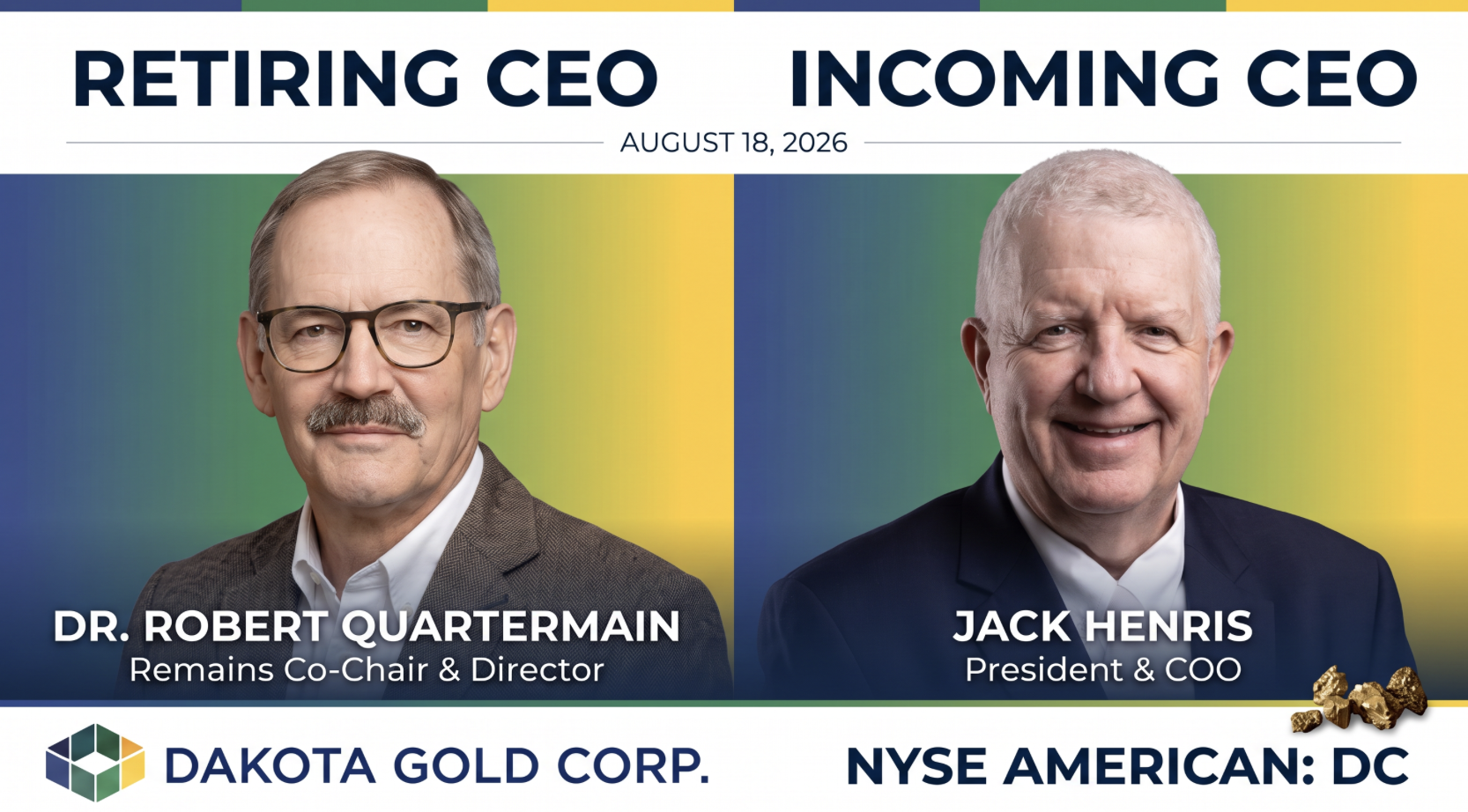
Dakota Gold Corp. (NYSE American: DC) is changing CEOs at the exact moment its flagship project shifts from exploration story to construction candidate.
Key Points
- Dr. Robert Quartermain retires as CEO on August 18, 2026, and remains Co-Chair and Director
- Jack Henris, President and COO for the past year, steps up as CEO on that date
- $107 million in cash reported in the March 2026 financial statements
- Funding secured for planned programs through 2028; Richmond Hill advanced to pre-feasibility
- Large-scale mine permit filing expected later this year
- Richmond Hill targets production as soon as 2029
The company announced that Dr. Robert Quartermain will retire as Chief Executive Officer on August 18, 2026, after holding the role since November 2024. He stays on as Co-Chair and Director. Jack Henris, who joined Dakota Gold a year ago as President and Chief Operating Officer, takes over as CEO on that date.
For small-cap investors, the timing matters more than the titles. Quartermain framed his tenure around two goals, and he claims both: advancing Richmond Hill to the pre-feasibility stage and locking in funding for planned programs through 2028. Board Co-Chair Stephen O’Rourke pointed to the balance sheet as evidence, citing $107 million in cash as of the March 2026 financial statements.
That funding position separates Dakota Gold from the typical micro-cap explorer, which usually arrives at the permitting stage with a thin treasury and a dilutive raise on deck.
A Homestake Career Comes Full Circle
Henris brings local credibility that no outside hire could replicate. He started his career at the Homestake Mine in 1987, and he now argues Richmond Hill could become the largest gold-producing mine in South Dakota. Quartermain’s continued board presence keeps the geological expertise in the room — a deliberate split between the exploration mindset that found the resource and the operating discipline required to build it.
Permitting Becomes the Critical Path
The supporting changes tell investors where the risk now sits. Shawn Campbell moves into a Chief Development Officer role covering shareholder engagement and construction financing for Richmond Hill. Amy Koenig continues as SVP, Chief Legal Officer and Corporate Secretary, and will manage permitting — drawing on regulatory and litigation experience at Black Hills Energy (NYSE: BKH) — as the company prepares to file its large-scale mine permit later this year.
Two functions, two bottlenecks: money and regulators. Dakota Gold assigned a named executive to each.
The Setup
Dakota Gold targets production at Richmond Hill as soon as 2029 while continuing to define high-grade underground potential at the Maitland Gold Project. Both sit on private land inside South Dakota’s historic Homestake District. Private land ownership removes a layer of federal permitting friction that slows comparable U.S. projects.
Quartermain also flagged the macro backdrop directly, pointing to strong gold prices and rising investor awareness — the tailwind that turns a permit filing into a re-rating catalyst rather than a line item.
Watch the large-scale mine permit filing. That’s the next real milestone.