From Bitcoin to Zcash: Why Some Crypto Veterans Are Making the Switch

Bitcoin has done its job. It put crypto on the map, survived every existential threat thrown at it, and earned its place as the premier institutional-grade digital asset. But a growing cohort of sophisticated investors — people who were early to Bitcoin — are now quietly rotating a portion of their holdings into Zcash (ZEC), and the reasons why say a lot about where the crypto market is heading.
Bitcoin’s Transparency Problem
Bitcoin was designed to be trustless and decentralized — but it was never truly private. Every transaction, wallet address, and transfer amount is permanently recorded on a fully public ledger. As blockchain analysis software from firms like Chainalysis has grown more powerful, and as exchange KYC requirements have become standard, Bitcoin’s on-chain activity has become increasingly traceable — a development that sits uneasily with investors who originally valued the asset’s financial autonomy.
That concern has become more acute in 2026. The EU’s DAC 8 directive, effective this year, now requires crypto service providers to collect users’ tax information, and conversations around wealth taxes have intensified on both sides of the Atlantic. The Netherlands has introduced a tax on unrealized gains, and California is actively discussing similar measures — raising an uncomfortable question: if governments can analyze Bitcoin’s transparent blockchain to determine asset holdings, how sovereign is that asset really?
Enter Zcash
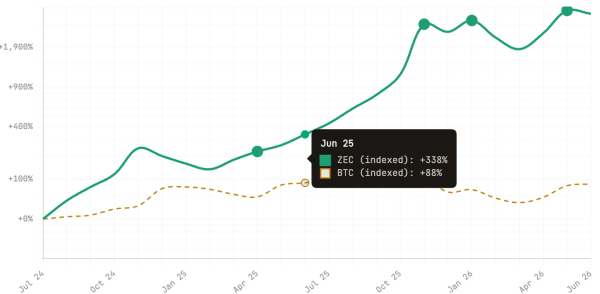
Zcash employs zk-SNARK cryptography to verify transactions without revealing balances, wallet addresses, or transaction amounts — providing the scarcity and monetary properties of Bitcoin with an added layer of financial privacy that Bitcoin simply cannot offer.
The investment thesis was articulated bluntly by Multicoin Capital co-founder Tushar Jain, who disclosed in May 2026 that his firm had been accumulating ZEC since February. His framing: “I used to think privacy only mattered for payments, not for store of value. Now I think privacy also matters for SoV due to wealth taxes. No intelligent investor is using fiat-pegged stablecoins as a SoV, so you need a private and scarce SoV. ZEC has a credible shot at being the main private SoV.”
Naval Ravikant put it more succinctly: “Zcash is insurance against Bitcoin.”
The Institutional Moment
What’s different in 2026 isn’t just the rhetoric — it’s who’s behind it. Major players including the Winklevoss twins and Barry Silbert are again accumulating ZEC, while Grayscale is exploring converting its Zcash Trust into a full spot ETF. If approved, initial ETF inflows are projected in the $500 million to $2 billion range within the first 12 months — a potential institutional catalyst that would fundamentally change the asset’s liquidity profile.
Year to date as of late May, ZEC is up roughly 25%, with a sharper 85% move over the prior 30 days, making it one of the strongest performing assets in a crypto market that has otherwise struggled for direction.
A Complement, Not a Replacement
None of this means Bitcoin is finished. Bitcoin maintains clear dominance in liquidity, ETF listings, derivatives volumes, and institutional adoption, and the two assets serve different functions in a portfolio. Zcash represents just 0.3% of the broader digital currency market — but if it were to capture just 5% of that segment, its value would be roughly 18x greater.
The rotation happening now isn’t a bet against Bitcoin. It’s a bet that financial privacy will matter more — not less — as governments, AI, and surveillance infrastructure tighten around the crypto economy. For investors who built wealth in Bitcoin but are growing uneasy with how visible that wealth has become, Zcash is emerging as the logical hedge.